


4 min read
How NCCER Training Gets You Closer to BCSP Certification
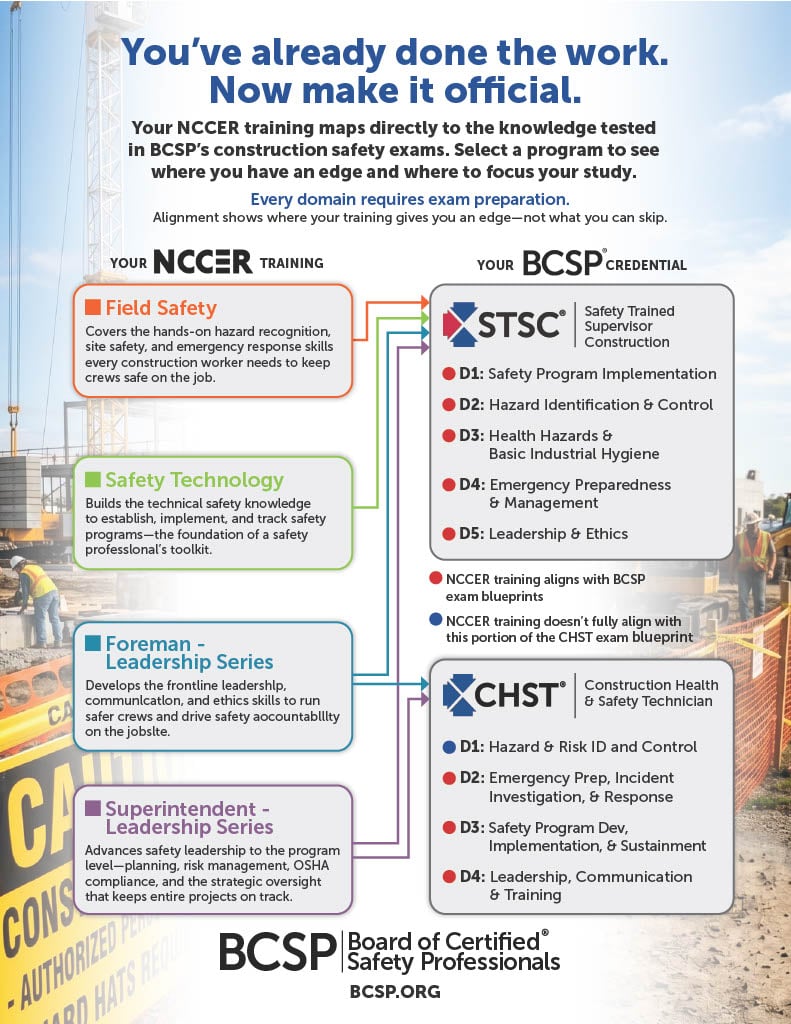
Many construction professionals build safety knowledge through the National Center for Construction Education and Research (NCCER) training without...
2 min read
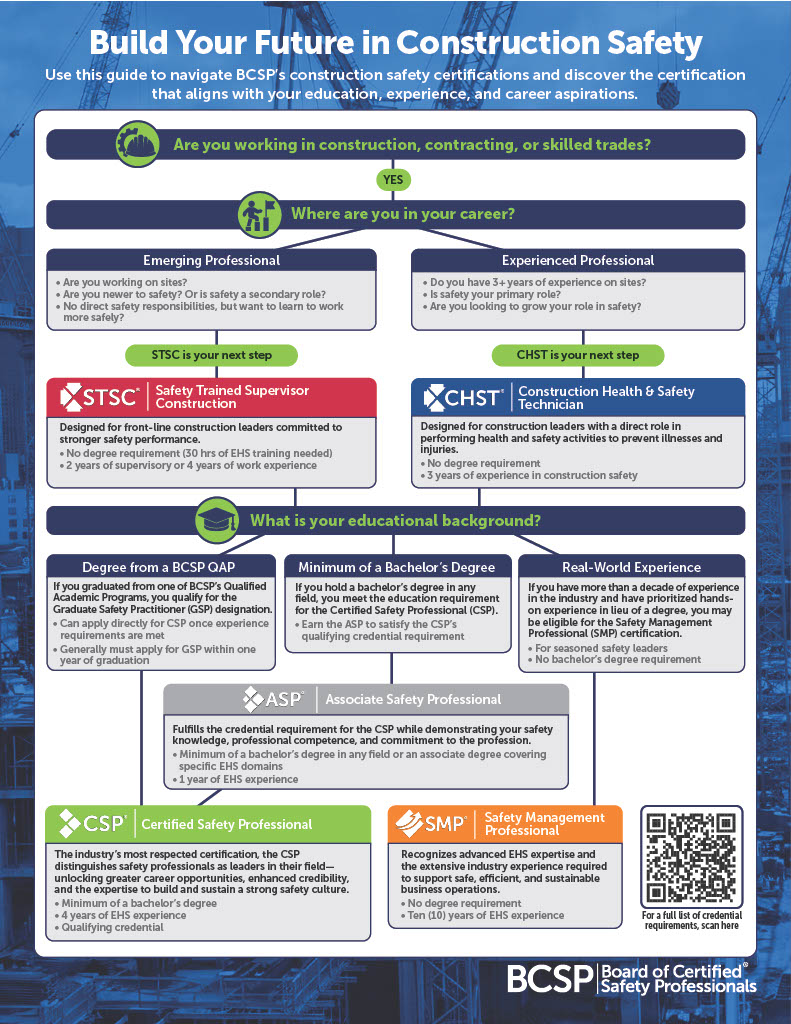
Construction safety responsibilities can look different depending on where you are in your career. You might be a frontline supervisor with safety as a part of your job, a dedicated construction safety professional, or an experienced leader managing safety across an organization.
BCSP offers certifications for each of these stages. Your experience, education, and current responsibilities can help determine which credential makes the most sense for you.
The Safety Trained Supervisor Construction (STSC) is designed for frontline construction leaders who have safety responsibilities as part of their role. It can be a good fit for professionals working onsite who supervise others, are newer to safety, or just want to strengthen their safety knowledge.
The STSC does not require a degree, but candidates do need 30 hours of EHS training. Eligibility also requires two years of supervisory experience or four years of work experience.
Consider the STSC if safety is part of your construction role but isn't necessarily your primary responsibility.
For those who have moved into more direct safety responsibilities, the Construction Health and Safety Technician (CHST) offers a construction-specific credential.
The CHST is designed for construction professionals who perform health and safety activities aimed at preventing workplace illnesses and injuries. No degree is required, but candidates do need three years of experience in construction safety.
Consider the CHST if you have several years of construction safety experience and safety has become a primary part of your role.
For some construction safety professionals, education provides a more direct route toward advanced certification. Graduates of a BCSP Qualified Academic Program (QAP) may qualify for the Graduate Safety Practitioner (GSP) designation. Rather than requiring candidates to earn the ASP or another qualifying credential, the GSP provides a pathway toward the Certified Safety Professional (CSP).
Once the required professional safety experience is met, GSP holders can apply for the CSP.
Consider the GSP if you graduated from a BCSP QAP and are planning to pursue the CSP.
The Associate Safety Professional (ASP) is another common pathway toward the CSP. The ASP demonstrates safety knowledge and professional competence while fulfilling the CSP’s qualifying credential requirement. Candidates need at least a bachelor’s degree in any field, or an associate degree that includes specified EHS coursework, along with at least one year of professional safety experience.
For construction professionals who meet those requirements, the ASP can provide a clear next step toward advanced certification.
Consider the ASP if you have the required education and safety experience and want to progress toward the CSP.
The Certified Safety Professional (CSP) is for experienced safety leaders who are ready to demonstrate an advanced level of professional practice. Candidates need a minimum of a bachelor’s degree, four years of professional safety experience, and a BCSP-approved qualifying credential.
For construction safety pros, earning the CSP can distinguish the expertise you’ve built through years of managing hazards, helping build stronger safety programs, and protecting workers.
Consider the CSP if you’ve built substantial safety experience and are ready for an advanced certification that reflects your expertise.
Extensive industry experience can also provide a path to certification. The Safety Management Professional (SMP) recognizes seasoned professionals who have developed their knowledge through extensive industry experience. Requirements include 10+ years of safety experience where managing safety programs, processes, and procedures are part of the job. A bachelor’s degree is not required.
Consider the SMP if you’re an experienced safety leader with hands-on industry and management experience seeking an advanced certification reflecting the same commitment to excellence that defines the CSP.
The right certification for you depends on the experience and education you bring to the profession, as well as where you want your career to go. Use the infographic above to explore BCSP’s construction safety pathways and identify the credential that may be your next step.
You can also learn more about how your NCCER training may get you closer to a BCSP credential here.
# # #
Visit BCSP.ORG for current eligibility requirements and other information on achieving certification.
4 min read
Many construction professionals build safety knowledge through the National Center for Construction Education and Research (NCCER) training without...
3 min read
Your BCSP certification exam is coming up, and you’ve done all your studying—but now you’re not sure what to expect from the actual exam-taking...

1 min read
Reagan Branch, CSP, CIH is encouraging women to embrace careers in construction safety. Construction is a career field not traditionally gender...